

New Tech Tuesdays
Join Mouser’s Technical Content team for a weekly look at all things interesting, new, and noteworthy for design engineers.
Published February 17, 2026
There’s a certain nostalgia in the early microcontroller experience—simple headers, a handful of GPIOs, and that first “blink” that reassured you the board was alive and your toolchain was working. But as embedded systems evolve toward artificial intelligence (AI)-enhanced sensing, machine learning at the edge, and increasingly autonomous robotics, yesterday’s tools aren’t always equipped for tomorrow’s challenges.
This week’s New Tech Tuesdays looks at a modern solution that bridges this divide: hybrid platforms that combine Linux-based application processors with a real-time microcontroller. This dual-architecture design creates a powerful foundation for advanced Internet of Things (IoT), robotics, and edge-AI applications while retaining wide compatibility with established development tools, libraries, and expansion hardware.
A New Hybrid Era in Embedded Computing
In many traditional designs, engineers choose between the flexibility of a single-board Linux computer and the deterministic behavior of a microcontroller. A hybrid platform removes that trade-off by integrating a high-level application processor running a Linux-class operating system for computing-intensive workloads with a low-power microcontroller running a real-time environment for time-critical tasks.
To bridge the two compute domains, hybrid platforms generally incorporate an interprocessor communication system—often based on remote procedure call (RPC)—that enables high-level applications to call real-time functions and vice versa. This approach enables high-level software to request precise operations, such as sensor measurements, actuator commands, or motor control, while microcontroller firmware can trigger advanced computing workloads like data processing, logging, or machine vision pipelines.
This architecture transforms what was traditionally a single-threaded microcontroller setup into a distributed compute model, where each domain handles the tasks it’s best suited for, ultimately simplifying development and reducing system-level complexity.
The Benefits of Combining Linux and a Microcontroller
Modern embedded design rarely involves a single computational need. Microcontroller-based real-time control loops must coexist with local inference models, high-resolution imaging, cloud or network communication, rich user interfaces, and data processing pipelines.
The hybrid approach addresses these demands by offering hardware acceleration and domain-appropriate processing through the Linux application processor. Depending on the underlying system-on-chip (SoC) and software stack, these processors can support OpenGL, Vulkan, hardware video engines, dual image signal processors (ISPs), and real-time peripherals. The result is a platform that can power a lightweight Linux graphical user interface (GUI) over supported display interfaces while simultaneously running deterministic, microcontroller-based control loops alongside Linux applications for robotics.
Designed for Advanced Prototyping and Real-World Applications
Engineers working in areas like machine vision, edge AI, building automation, or sensor-rich IoT applications often face the challenge of balancing performance with determinism. The hybrid platform approach excels in several key scenarios:
- Robotics: vision-informed navigation with microsecond-accurate motor control
- Edge AI: local processing of audio, images, or sensor data without cloud latency
- Home and building automation: real-time environmental control with on-board intelligence
- Educational solutions: a unified way to teach Linux, microcontroller programming, and AI workflows
- Prototyping for industry: faster development of advanced mixed-domain systems
In each case, the hybrid platform’s dual-processor architecture reduces integration friction and opens the door to more ambitious embedded designs.
The Newest Products for Your Newest Designs®
For designs that require the advantages of a hybrid processing architecture, the Arduino UNO Q Platform (Figure 1) integrates a quad-core Linux-capable application processor with a real-time microcontroller in a single development board. It offers dual-band wireless connectivity, embedded multimedia card (eMMC) storage options, LPDDR4X memory, USB-C with DisplayPort Alt-Mode, and compatibility with ecosystem hardware, including shields, carriers, and Qwiic accessory modules. Its hybrid architecture enables simultaneous Linux-level computing and real-time control, making it ideal for AI-enabled IoT, robotics, and embedded computing applications.
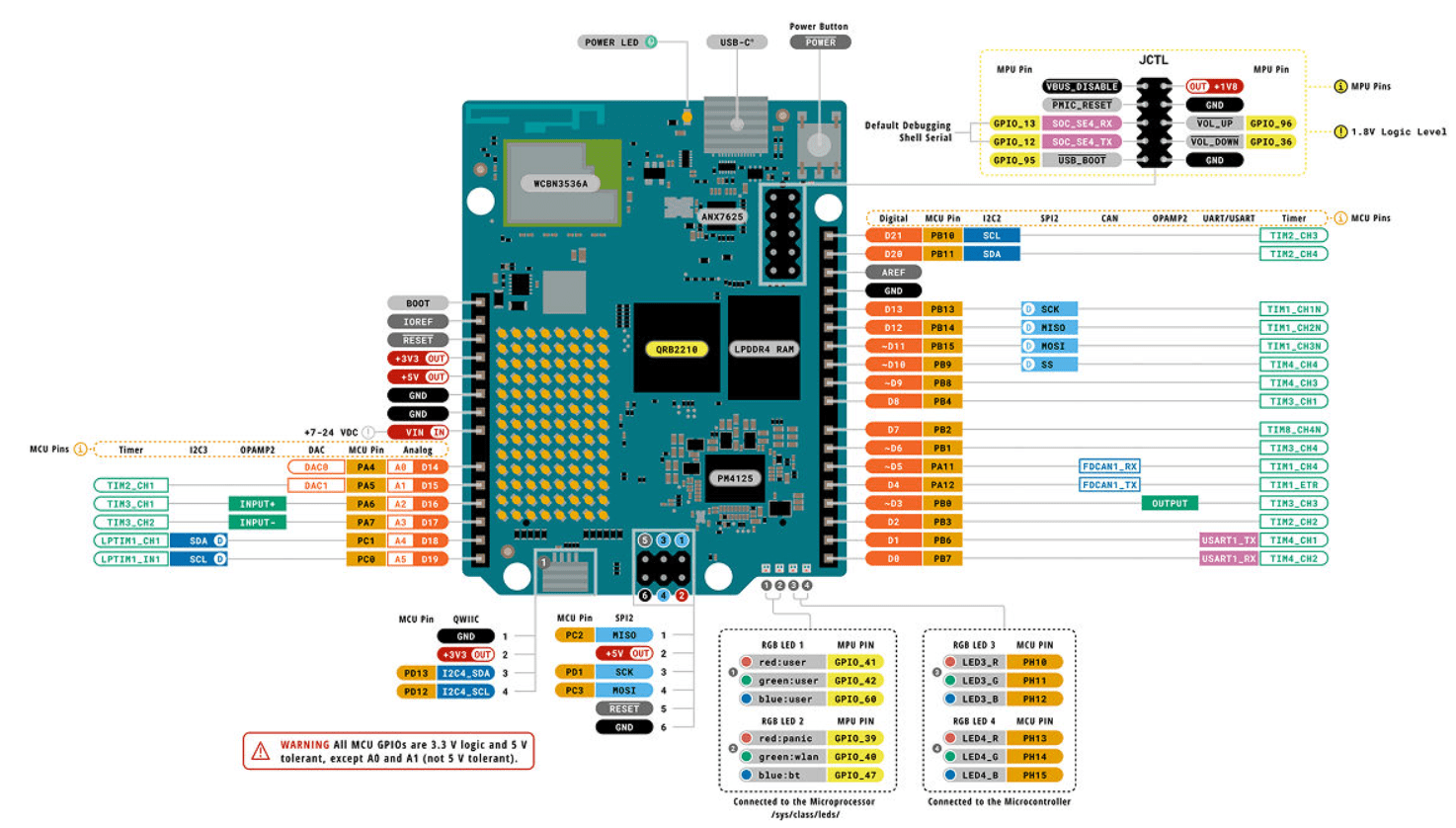
Figure 1: Arduino UNO Q pinout. (Source: Arduino)
Tuesday’s Takeaway
The Arduino UNO Q’s hybrid Linux-plus-MCU platform signals a new direction for embedded engineering. By unifying high-performance computing with deterministic real-time control without sacrificing ecosystem compatibility, this hybrid platform gives developers a uniquely flexible foundation for designing the next generation of intelligent, responsive devices.
